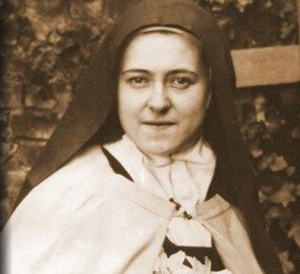
St. Therese of Lisieux
I recently published a personal essay in Chapter 16, the excellent literary magazine of Humanities Tennessee, about the privilege of bringing Holy Communion home to my mother-in-law in the months prior to her passing in the spring of 2025. There’s a passage where I write about St. Thérèse of Lisieux’s autobiography, The Story of a Soul, and the many parts of it that I love that I think my mother-in-law would have enjoyed. To write the essay, I went back to my copy of the book—a TAN Classics version translated from the French by Michael Day—to see what I had underlined when I read it. A line in Chapter 10, “The Way of Love,” clearly attracted me:
Prayer, for me, is simply a raising of the heart, a simple glance toward Heaven, an expression of love and gratitude in the midst of trial, as well as in times of joy.
It’s a beautiful definition of prayer. I wound up using it in the essay to give words to the experience of what it was like—for both of us, I believe—serving as my mother-in-law’s eucharist minister.
One morning, months after the essay was written, I was reading my copy of the Catechism of the Catholic Church to prepare a lesson for my 3rd and 4th grade Sunday School class. We were studying the Cardinal Virtues that week. I’m not sure why, but I suddenly felt compelled to see what the Catechism said about prayer. It’s in Part 4.
After a brief introduction, the question is asked: “What is Prayer?” This is the first answer:
For me, prayer is a surge of the heart; it is a simple look turned toward heaven, it is a cry of recognition and of love, embracing both trial and joy.
The very first explanation of what prayer is—albeit in a different translation from the one I used—is the same passage by St. Thérèse of Lisieux that had moved me months earlier. After reflecting for a few days on what was surely the divine providence that led me to the quote, I thought about St. Thérèse’s incredible impact on our faith.
She was in her early 20s when she wrote the manuscripts that would eventually be compiled after her death at age 24 into The Story of a Soul. While in her last days it’s clear she wanted her words to be shared, she couldn’t have imagined the impact they would have; that she would be called the “greatest saint of modern times” before she was even a saint; and then canonized in 1925, just 28 years after her death. Pope John Paul II named her a Doctor of the Church in 1997, placing her alongside St. Augustine, St. Catherine of Siena, St. Teresa of Avila, St. John of the Cross, St. Thomas Aquinas and others.
Somewhere along the way, when church leaders, and Canon lawyers, and theologians were making the first major update in 400 years to the Catechism of the Catholic Church in the late 20th century, when they got to the section on prayer, somebody in the room offered up The Story of the Soul, pointed their finger to a passage on a page in Chapter 10, and said, “This … this is it.”
Maybe, like me, that person had been thinking about something else and felt a sudden compulsion to see what St. Thérèse of Lisieux said about prayer.
And there it was.